
What Does 2026 Have in Store for the Food Manufacturing Industry?
Whats the outlook for 2026?
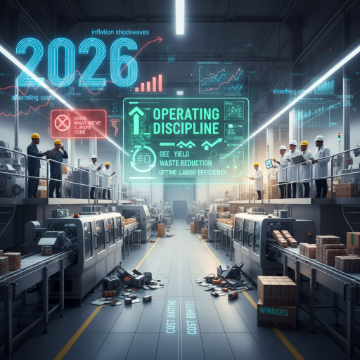
If 2024 was about surviving inflation shockwaves and 2025 was about stabilising (while quietly absorbing new costs), 2026 looks like the year the rules of competitiveness sharpen.
Not every manufacturer will feel it in the same way. Some will thrive. Some will tread water. A few will discover—too late—that “doing what we’ve always done” isn’t a strategy anymore.
Here’s what 2026 is likely to bring, and what smart operators will do about it.
1) The cost battle shifts from “inputs” to “operating discipline”
Commodity pricing and energy volatility won’t disappear, but the bigger separator in 2026 will be how well a site runs.
- Right-first-time, yield, waste, uptime and labour efficiency become board-level topics (again).
- Expect renewed focus on OEE, preventative maintenance, line changeover reduction, and better planning discipline.
- The winners won’t just negotiate better, they’ll execute better.
What to do now: treat operational excellence like a revenue lever, not a “continuous improvement project”.
2) Labour remains tight… and more expensive in the places you can least afford it
Even when headcount stabilises, labour cost pressure tends to creep, especially in technical, engineering, quality and high-performing frontline leadership.
In 2026, the big challenge won’t be “can we hire people?” but:
- can we hire capable people fast enough?
- can we retain them without creating internal pay compression?
- can we upskill supervisors and team leaders quickly?
What to do now: build a workforce plan by role family (ops, engineering, quality, supply chain), not just “heads”.
3) Retailers and brand owners keep the pressure on - just in smarter ways
Retailers will still expect value, resilience and speed. But the pressure increasingly shows up as:
- tougher service expectations (OTIF, penalties, rapid response)
- tighter technical requirements (spec, traceability, audit performance)
- shorter lead times on innovation and reformulation
Manufacturers who can combine quality + agility + cost discipline will become preferred partners.
What to do now: identify where you can be “easy to do business with” (service, responsiveness, technical confidence) and make it a selling point.
4) Regulation and assurance keep rising - especially around claims and transparency
“Trust” is a commercial asset now. Businesses will feel more scrutiny around:
- provenance and claims (e.g., “natural”, “healthy”, sustainability language)
- allergen controls, food safety culture, and audit readiness
- traceability expectations and speed of recall response
This isn’t just compliance - it’s brand protection for you and your customers.
What to do now: invest in systems and leadership that make assurance repeatable, not heroic.
5) Automation becomes less optional - and more targeted
2026 won’t be about futuristic fully automated factories. It’ll be about pragmatic automation:
- end-of-line and palletising
- vision systems and in-line inspection
- digital maintenance, spares management, condition monitoring
- scheduling and forecasting tools that actually get used
The best ROI comes from removing bottlenecks and stabilising variability.
What to do now: map your top 3 constraints and automate those, not what looks coolest on a tour.
6) Sustainability moves from “reporting” to “commercial advantage”
Sustainability isn’t going away and it’s starting to sort suppliers.
Expect more customer-driven requirements around:
- packaging reduction and recyclability
- energy efficiency and emissions reporting
- water usage and waste reduction
The businesses that can prove progress (not just promise it) will win more tenders and better partnerships.
What to do now: quantify, prioritise, and communicate improvements with evidence and cadence.
7) Consolidation and distress will create both risk and opportunity
A few manufacturers will struggle under debt costs, input volatility hangover, customer concentration, or chronic operational underperformance. That creates:
- acquisition opportunities
- customer re-tenders
- talent availability from businesses that downsize
But it also creates supply risk if a critical supplier wobbles.
What to do now: stress-test your supply base and keep a live “opportunity radar” for talent and customers.
8) The biggest differentiator in 2026: leadership depth
Here’s the quiet truth: many plants don’t have a process problem, they have a leadership bandwidth problem.
In 2026, performance will correlate strongly with:
- confident site leadership
- credible engineering and maintenance strategy
- a quality culture that prevents issues rather than reacting to them
- strong middle management who can deliver change without burnout
What to do now: develop your supervisors and middle leaders like your margin depends on it, because it does.
What should manufacturers prioritise for 2026?
If you want a simple 2026 scoreboard, focus on these five:
- Operational stability: reduce variability and stop firefighting
- Capability hiring: engineering, quality, ops leadership
- Assurance strength: traceability, audit readiness, claims confidence
- Targeted automation: fix constraints, stabilise labour dependency
- Commercial agility: responsiveness, service, and innovation speed
Final thought
2026 won’t necessarily be “easier”—but it can be better for the manufacturers who treat this as a year to tighten execution, invest with intent, and hire the right capability early.
The industry is still full of opportunity. It’s just moving to the businesses who run sharper operations, build stronger teams, and make themselves indispensable partners.


.jpg)